Management interventions
To protect and restore Jurinea cyanoides, we are applying active management across 23.8 ha in Czechia and 72.3 ha in Germany. Key actions focus on suppressing major threats through tree and shrub removal, rotational grazing, mowing, manual and mechanical bare soil creation, and the targeted removal of invasive species.
Set up of plots for management interventions
Aim: To prioritize the sites and measures and mark them in the field
- Suggest appropriate management actions based on the results of WP 2 and WP 3.
- Physically identify and mark the boundaries of the suggested actions directly on site.
- Capture the exact geographic coordinates of all marked interventions.
- Import the recorded GPS data into QGIS and generate the corresponding shapefile layers.
- Review and verify the spatial extent of the implemented management interventions every year.
- Assess and monitor the intensity of the ongoing management work every year.
- Adapt and update the scope or intensity of future actions according to the evaluation results.

Reduction of intensive shading and wood competition
Aim: to reduce shading and competition by removing of shrubs and trees on 22 ha in Czechia and 46.9 ha in Germany
- Remove trees and shrubs in a mosaic pattern to restore open habitats and preserve landscape heterogeneity.
- Retain valuable mature trees (e.g., oaks and pines) to maintain beneficial partial shade and structural diversity.
- Apply initial mulching to clear dense biomass and suppress unpalatable or invasive species.

Reduction of competition by grazing
Aim: to reduce competition and biomass accumulation by introduction of grazing on 12 ha in Czechia and 14.3 ha in Germany
- Introduce annual grazing (contracted as an external service once per year in CZ and DE) to reduce competition and enhance plant fitness.
- Suppress dominant grasses, shrubs, pioneer trees, and their resprouting to prevent competitive displacement of J. cyanoides.
- Create patches of bare soil through trampling to enable the rejuvenation of typical plant species.
- Form a mosaic of microhabitats with sparse or low vegetation to support high overall biodiversity.
- Shift microhabitats and floral resource availability to support flower-visiting insects and foster positive shifts in community composition.
- Deploy preferred livestock (cattle, horses, or donkeys) based on their feeding preferences, or utilize sheep and goats where preferred animals are unavailable.
Reduction of competition by mowing
Aim: to reduce competition, accumulation of old biomass or to prepare sites for grazing by mowing on 12 ha in Czechia and 16.6 ha in Germany
- Mow target areas once or twice per year (using a combination of external contractors and internal staff) to suppress competitively strong plants.
- Mow selected sites prior to grazing to prepare the habitat for livestock.
- Mow remaining ungrazed biomass following grazing cycles to maintain low vegetation structure.
- Rake and remove all cut biomass from the sites to prevent nutrient accumulation.
- Involve volunteers and students (via School Patronage) to assist with manual raking and biomass removal.
Creation of open patches without vegetation
Aim: to create bare soil patches without vegetation on 12 ha in Czechia and 33.3 ha in Germany by removing top-soil layer using diggers or manually by raking and removing moss, lichen and litter layers
- Remove topsoil using diggers to create open patches of bare soil required for seed germination.
- Manually rake and remove moss, lichen, and plant litter to expose the bare substrate and favor J. cyanoides recruitment.
- Strip nutrient-rich topsoil to prevent rapid weed regeneration and maintain low-nutrient conditions.
- Expose bare soil patches to provide essential nesting microhabitats for ground-nesting bees, wasps, and beetles.
Suppression of invasive species
Aim: To develop and implement targeted control strategies for suppressing invasive alien species (IAS) across project sites, prioritizing early detection and complete removal.
- Execute IAS removal following the expert study (prepared under WP 2) using site-specific methods.
- Manually remove invasive plants in combination with selective herbicide applications to eliminate target species.
- Target high-risk species—specifically those on EU and national priority lists (e.g., Ailanthus altissima, Robinia pseudoacacia, Bunias orientalis, Rhus spp., Senecio spp., and Rubus armeniacus).
- Intervene in early spreading phases to maximize eradication success and minimize long-term management costs.
Support of pollinators
Aim: to establish buffer zones along site boundaries using regional seed mixtures and other measures to support pollinator occurrence
- Develop and apply regional wildflower seed mixtures tailored to site-specific conditions and local pollinator requirements to provide continuous floral resources.
- Harvest seeds using a brushing machine repeatedly throughout the vegetation season to maximize species diversity in the mixtures.
- Hand-collect seeds of species that cannot be harvested mechanically or yield low seed quantities.
- Establish "mother plantations" (e.g., Dianthus) at ČSOP Vlašim and IBOT to propagate hand-collected species.
- Clean, process, and store harvested seeds from both direct field collection and mother plantations for future mixture blending.
- Sow the custom seed mixtures to establish functional buffer zones along site boundaries.
Suppression of seed herbivory
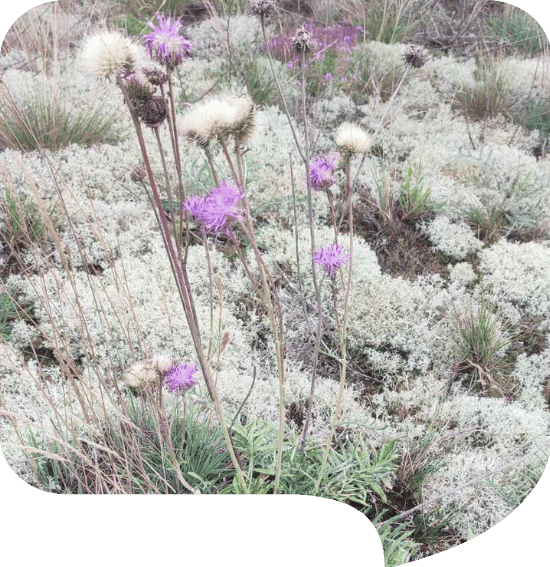
Aim: Reduce the seed herbivory to a level that does not threaten the long-term survival of Jurinea cyanoides populations
- Implement target suppression measures as defined by the expert study once herbivore species are identified.
- Deploy physical protection (e.g., nylon netting/fences) around population subsets post-pollination (proposed method).
- Support natural antagonists to encourage biological control of herbivores (proposed method).
- Execute specialized field interventions led directly by IBOT staff according to final study findings.

Additional interventions for securing plant survival
Aim: To support plant growth by specific interventions
- Plant native trees (pines and oaks) in target areas to establish long-term natural shade and reduce drought stress.
- Install temporary artificial shading to protect sensitive seedlings and young plants from high temperatures and heat stress until planted trees mature.
- Fence selected patches to protect vulnerable plants from animal grazing and trampling.


Project activity achievements
The activities haven't started yet.
Activity leader
Project Partners

Financing
Co-funded by the European Union. Views and opinions expressed are however those of the author(s) only and do not necessarily reflect those of the European Union or CINEA. Neither the European Union nor the granting authority can be held responsible for them.